
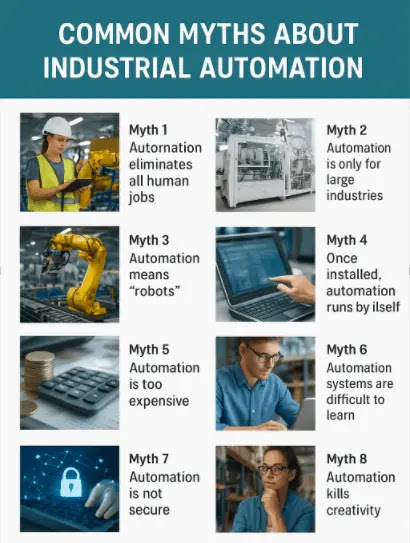
Common myths about Industrial Automation related to creativity, learning, installation & security and what actually happens in real factories and plants.
1. “Automation will eliminate all jobs”
Reality: Automation primarily changes the nature of work rather than eliminating entire professions.
Many repetitive, uncertain, dangerous, or highly manual tasks become automated, but parallelly new roles appear in:
- Automation Engineering
- PLC/HMI engineering
- maintenance
- data analytic
- cybersecurity
- systems integration
2. “Automation is only for huge factories”
Reality: Use of Control & Automation system in small and medium manufacturers is increasing day-by-day.
Affordable:
- low-cost sensors
- compact PLCs
- cloud monitoring systems
- collaborative robots
3.“Automation systems are difficult to learn”
Reality: The programming language of PLC is easy to grasp, if you have a common sense in understanding the logic.
Affordable:
One thing to note is that industrial automation courses are first of all open to learning from even diploma or ITI levels, to graduation levels. The engineering streams which are allowed to study this course are electronics, electrical and instrumentation. Even mechanical engineers who are interested in programming can learn this, as mechatronics and robotics are largely associated with this field. So, you can imagine a vast amount of opportunity open for the students to learn this topic.
4. “Automation means just robots”
Reality: Industrial automation is much broader than robotics.
It includes:
- PLC & SCADA systems
- DCS Programming Software
- Sensors and actuators
- motion control
- AI vision systems
- Process control
- digital twins
- MES/ERP integration
5. “Automation guarantees zero defects”
Reality: errors can be reduced by Automation, but cannot eliminate them completely.
Problems can still occur due to:
- poor calibration
- sensor failure
- incorrect programming
- material variation
- mechanical wear
6. “Automation is too expensive”
Reality: the cost barrier has dropped significantly.
Modern automation often delivers ROI through:
- reduced waste
- faster production
- lower downtime
- energy savings
- improved quality
7. “Once installed, automation runs forever”
Reality: continuous maintenance is required for automation system.
Industrial systems need:
- firmware updates
- preventive maintenance
- backups
- cybersecurity patches
- sensor replacement
- recalibration
8. “Automation makes factories unsafe”
Reality: Safety is improved by using properly designed automation system
Automation helps reduce:
- exposure to chemicals
- heavy lifting injuries
- repetitive strain
- high-temperature exposure
- dangerous machine interaction
9. “AI will instantly replace traditional automation”
Reality: AI complements automation more than it replaces it.
Traditional control systems are still essential because factories need:
- deterministic behavior
- reliability
- real-time control
- safety certification
AI is mostly added for predictive maintenance, machine vision, anomaly detection and optimization
10. “Automation instantly increases productivity”
Reality: productivity can be reduced if the automation system is not properly designed
Poorly planned systems may cause:
- bottlenecks
- integration failures
- operator confusion
- downtime
- excessive complexity